Skip to content
Dr. Khalid AletaibiConservative Dentistry · Dubai

PREVENTIVE DENTISTRY

Your teeth cleaning, step by step.

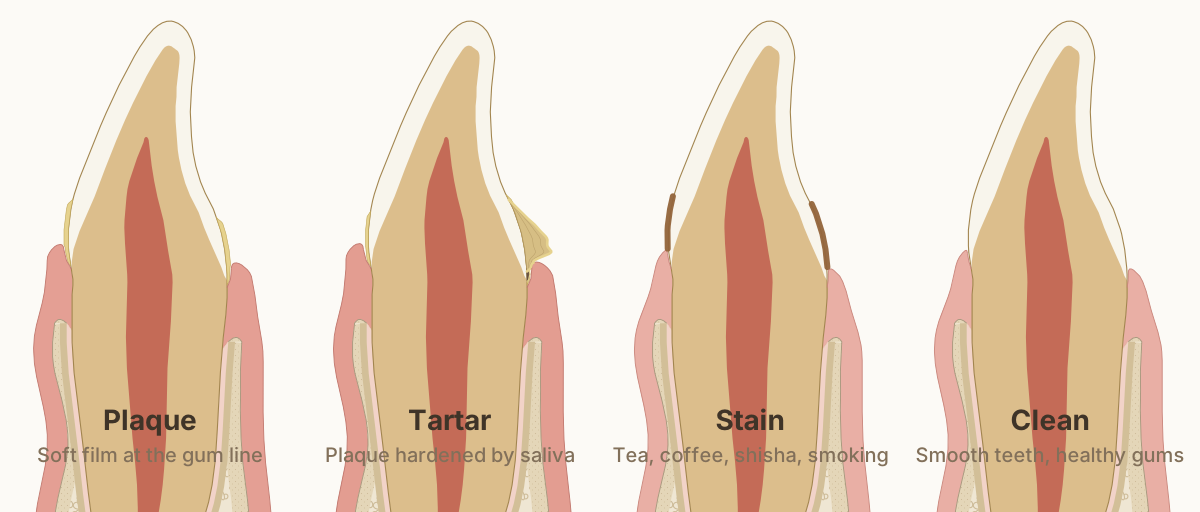
The same lower front tooth four times, cut from the lip side to the tongue side: a soft film of plaque at the gum line; pale tartar on the tongue side; a brown stain along the gum line; and the tooth clean, with healthy gums.

A professional cleaning, the scale and polish most people know, leaves your teeth smooth and fresh, removes the tartar and stain that brushing leaves behind, and shows you clearly how your gums are doing. Dr. Khalid carries out every cleaning himself, so the person cleaning your teeth is the dentist who examines them. A routine visit in Jumeirah, Dubai takes about 30 minutes: ultrasonic scaling for tartar, air polishing (often called Airflow) for stain and plaque, and a few minutes of coaching so the result lasts until your next visit.

Dr. Khalid AletaibiWritten by Dr. Khalid Aletaibi, DHA-licensed dentist

QUICK ANSWER

A professional cleaning removes three things: plaque, the soft film of bacteria that forms on teeth every day; tartar, which is plaque that has hardened with minerals from saliva [1]; and surface stain. Hardened tartar is fixed to the tooth and always carries live plaque on its surface [2], so brushing cannot lift it and a cleaning is how it comes off. The evidence is encouraging: regular scale and polish keeps tartar lower, with six-monthly visits slightly ahead of yearly ones [3]; a cleaning does more when it comes with coaching, which is why every visit includes it [4]; and gum disease is prevented by daily cleaning at home plus professional removal of plaque every three or six months [5].

Who cleans

Dr. Khalid himself

Time

About 30 minutes

Anaesthetic

Usually none for a routine clean

Tooth structure removed

None

Next visit

4, 6 or 12 months, set for you

What a cleaning removes: plaque, tartar and stain

Plaque is the soft, sticky film of bacteria that builds up on teeth every day. Brushing and cleaning between the teeth remove most of it, and where some is missed, minerals from saliva harden it into tartar, which dentists call calculus [1]. Tartar always carries a layer of live plaque on its surface [2] and keeps it in place along the gum line. Once tartar has set, a toothbrush cannot remove it; it comes off at a cleaning.

In people who brush daily and see the dentist regularly, tartar above the gum forms mainly on the teeth next to the openings of the salivary glands [1]. Those openings sit under the tongue, behind the lower front teeth, and in the cheeks beside the upper back teeth, which is why a rough edge is often felt first on the inside of the lower front teeth. Tartar-control toothpastes help before tartar sets: they slow the hardening and keep fresh deposits soft enough to brush away [1]. Whatever has already set is lifted at your cleaning.

A cleaning also lifts stain. Tea, coffee, shisha and smoking leave yellow and brown marks on the surface of the teeth, often as a darker rim along the gum line and between the teeth. In a laboratory study of tobacco stain, air polishing with a low-abrasive powder removed it as well as coarser powder and pumice did, without roughening the enamel [6]. A cleaning lifts what sits on the surface; for a shade lighter than your teeth's own, teeth whitening is planned once the teeth are clean and the gums are healthy.

Tartar above the gum forms most on the tongue side of the lower front teeth, next to where saliva enters the mouth, and always carries live plaque. Brushing removes plaque; tartar comes off at a cleaning.

Diagram page and reuse terms: Where plaque, tartar and stain sit

Sources and measurements
  • Where tartar forms: in 40 patients, tartar above the gum was by far highest on the tongue side of the lower front teeth; across 627 people, the lateral incisors carried about 70% and the canines about 45% of the central incisors' amount (Macpherson 1995). DOI 1, Where plaque, tartar and stain sit
  • Two kinds of tartar: above the gum it is yellow-white, layered and about 37% mineral by volume; below the gum it is dark brown, uniform and about 58% mineral, usually a thin, smooth veneer on the root (Friskopp and Isacsson 1984; Woelfel; Gurgan and Bilgin 2005). DOI 2, Where plaque, tartar and stain sit
  • Tartar always carries plaque: a living film of plaque covers mineralised tartar deposits, above and below the gum. DOI 3, Where plaque, tartar and stain sit
  • Healthy gum anatomy: the gum edge sits about 1 mm above the enamel's edge and healthy gums probe 1 to 3 mm (Woelfel's Dental Anatomy). Under a groove about 0.7 mm deep lie about 1 mm of attaching epithelium and 1 mm of fibres above the bone, Gargiulo's autopsy means, which vary from person to person. DOI 4, Where plaque, tartar and stain sit
  • The tooth: a lower central incisor in section, crown 9.5 mm and root 12.5 mm (Wheeler's Dental Anatomy, Table 7.1), with the lip side on the left. Pockets and openings are drawn slightly open so they can be seen; no number on the drawing is a measurement of one person.

What happens at your cleaning, step by step

First, a short update on your health and any medicines, then a careful look at your gums: where they bleed, how deep the pockets between gum and tooth measure, and whether the gum has drawn back from the tooth. Gums that bleed at fewer than one in ten of the measured points count as healthy, and bleeding at more points than that is gingivitis [7][8]; gums that do not bleed, visit after visit, are a reliable sign that they are stable [9]. If your gums need more than a routine cleaning can give, you hear it now, before anything else is done.

Next, a plaque dye, also called a disclosing solution. It colours the plaque so you can see it too, and it guides the cleaning to every place the plaque sits: in a randomised trial, a cleaning guided by the dye left about half as much plaque near the gum as the same cleaning without it [10]. The colour comes away as the teeth are cleaned.

Then ultrasonic scaling for the tartar. A fine tip vibrates in a spray of water, breaking tartar away from the teeth above the gum and just below it while the water rinses it off. Where a smoother finish is needed, a slim hand instrument completes the work. Either kind of instrument is accepted: in the review behind the European guideline on gum treatment, hand and ultrasonic instruments gave the same results, and the guideline recommends either or both [11][8].

Then air polishing (Airflow). A fine, low-abrasive powder carried in air and water lifts stain, the remaining plaque and soft deposits, including from the spaces between the teeth. Low-abrasive powders have been studied closely: glycine changed root surfaces less than coarser powders, and the gum less than coarser powders or hand instruments [12][13]; glycine and erythritol were the least abrasive on fillings and crowns in laboratory tests [14]; and repeated erythritol air polishing left enamel no rougher in a laboratory study [6]. People treated with these powders report the same or less discomfort than with hand or ultrasonic instruments [15][16][17], and in people having regular maintenance after gum treatment, air polishing gave the same clinical results as conventional cleaning, with more comfort and less time in the chair [18][19][20].

Polishing with a soft prophy brush or rubber cup follows, and only where stain remains. Polishing removes very little enamel, even when repeated over a lifetime [21], but over time it can wear the softer root surface and the outer, fluoride-rich layer of enamel [21][22], so it is kept to the places that need it.

Then fluoride, where your risk calls for it. A fluoride varnish painted on after the cleaning adds protection where the teeth need it, for example on exposed roots, with a dry mouth or after a run of new decay; in adults over 60, a 5% sodium fluoride varnish prevented about 64% of new decay on exposed roots [23]. More is on the fluoride treatment page.

Then a few minutes of coaching, the part that makes the cleaning last. You see what was missed, and where the gums are inflamed, Dr. Khalid shows you interdental brushes, the device European guidance recommends for cleaning between the teeth [8][24]. Cleaning and coaching work together: a professional cleaning added to coaching gave a further benefit over coaching alone [4], and for gums that are already inflamed, professional plaque removal improved the inflammation and lowered plaque, with some evidence that reinforcing home care adds to it [24].

Finally, your next visit. Dr. Khalid sets it at 4 months, 6 months or a year, from what your teeth and gums showed today, and reviews it each time you come. That sits within the UK's national guidance (NICE), which asks for every patient's interval to be set individually and never to be longer than 24 months for an adult or 12 months for anyone under 18 [25].

The gum check comes first; the dye then shows the plaque, the ultrasonic tip lifts the tartar and air polishing lifts stain, plaque and the dye. Thick plaque takes the darker colour; the colour says little about its age.

Diagram page and reuse terms: Your cleaning, step by step

Sources and measurements
  • The plaque dye: in a randomised trial of 32 patients, a cleaning guided by the dye left 6.1% of the gum-side surface with plaque against 12.0% without it. The dye's colours mostly show how thick the plaque is, not its age (Volgenant 2016). DOI 1, Your cleaning, step by step
  • Using an ultrasonic tip: the side of the last 1 to 2 mm is held close to parallel to the tooth with light pressure (maker's instructions; root damage was least at angles close to 0 degrees, Flemmig 1998). The tip moves only about 5 to 44 micrometres (Lea 2003). DOI 2, Your cleaning, step by step
  • Powders and restorations: across 42 laboratory studies, erythritol and glycine were the least abrasive powders on fillings and crowns, while sodium bicarbonate and calcium carbonate roughened them more. DOI 3, Your cleaning, step by step
  • Healthy gum anatomy: the gum edge sits about 1 mm above the enamel's edge and healthy gums probe 1 to 3 mm (Woelfel's Dental Anatomy). Under a groove about 0.7 mm deep lie about 1 mm of attaching epithelium and 1 mm of fibres above the bone, Gargiulo's autopsy means, which vary from person to person. DOI 4, Your cleaning, step by step
  • The European guideline (EFP S3): the aim is no pocket deeper than 4 mm that bleeds and none of 6 mm or more; sites are re-assessed after healing; hand or powered instruments, or both; supportive care every 3 to at most 12 months. DOI 5, Your cleaning, step by step
  • The tooth: a lower central incisor in section, crown 9.5 mm and root 12.5 mm (Wheeler's Dental Anatomy, Table 7.1), with the lip side on the left. Pockets and openings are drawn slightly open so they can be seen; no number on the drawing is a measurement of one person.

A close-up at the gum line on the tongue side, with a 1 mm scale. The side of the tip's last 1 to 2 mm, held close to parallel, chips the tartar away; it moves only hundredths of a millimetre.

Diagram page and reuse terms: The tip at work

Sources and measurements
  • Using an ultrasonic tip: the side of the last 1 to 2 mm is held close to parallel to the tooth with light pressure (maker's instructions; root damage was least at angles close to 0 degrees, Flemmig 1998). The tip moves only about 5 to 44 micrometres (Lea 2003). DOI 1, The tip at work
  • Two kinds of tartar: above the gum it is yellow-white, layered and about 37% mineral by volume; below the gum it is dark brown, uniform and about 58% mineral, usually a thin, smooth veneer on the root (Friskopp and Isacsson 1984; Woelfel; Gurgan and Bilgin 2005). DOI 2, The tip at work
  • Tartar always carries plaque: a living film of plaque covers mineralised tartar deposits, above and below the gum. DOI 3, The tip at work
  • The tooth: a lower central incisor in section, crown 9.5 mm and root 12.5 mm (Wheeler's Dental Anatomy, Table 7.1), with the lip side on the left. Pockets and openings are drawn slightly open so they can be seen; no number on the drawing is a measurement of one person.

Kind to the work already in your mouth

Veneers, bonding, composite fillings and crowns need a cleaning that keeps their surfaces smooth and their edges sealed. In laboratory studies, ultrasonic tips and coarser powders roughened some restoration surfaces, while erythritol and glycine powders were the least abrasive and are the ones recommended for removing stain and soft deposits [14]. So around bonded work, the low-abrasive powder does most of the cleaning, and the ultrasonic tip is kept to where there is tartar to remove.

Implants are checked and cleaned at every visit as well. Maintenance at a set interval lowers the risk of disease around implants, and a review of the evidence suggested a visit at least every five to six months [26]. When implants are part of your plan here, Dr. Khalid, our periodontist in the same clinic and the team make one plan together, from the same scans and X-rays, before anything is booked, so the finished result meets the standards of function, aesthetics and biomimetics. The finished tooth is designed first and becomes the brief the implant is placed to, rather than the tooth being fitted to wherever the implant ends up; our periodontist places the implant, Dr. Khalid makes the crown and stays on the case throughout, and they review the result together. More is on the dental implants and peri-implantitis pages.

Braces and clear aligners make some surfaces harder to keep clean, so cleanings during treatment matter. Orthodontic treatment here is team care: Dr. Khalid, our orthodontist in the same clinic and the team plan the case together from the same records before treatment starts, so the finished result meets the standards of function, aesthetics and biomimetics. That result is agreed first and becomes the brief the tooth movement is carried out to, and our orthodontist carries out the braces or aligner treatment. Dr. Khalid stays on the case throughout, with cleanings and gum checks along the way and any restorative finishing at the end, and they review the result together. More is on orthodontics and on treating white spots.

Grains drawn to scale beside a 15 micrometre bonded joint, with a 50 micrometre scale. Erythritol and glycine were the least abrasive powders on fillings and crowns in laboratory tests; grain size alone is not the reason.

Diagram page and reuse terms: Powder at a filling's edge

Sources and measurements
  • Powders and restorations: across 42 laboratory studies, erythritol and glycine were the least abrasive powders on fillings and crowns, while sodium bicarbonate and calcium carbonate roughened them more. DOI 1, Powder at a filling's edge
  • Grain size is not what makes a powder gentle: within glycine, the larger 65 micrometre grains did less damage than the 25 micrometre ones (Tada 2011). Grain sizes from the maker's table: erythritol about 14, glycine 25 or 65, sodium bicarbonate 40 or 65 micrometres. DOI 2, Powder at a filling's edge
  • The bonded joint: in a laboratory study of composite restorations through four cleaning cycles, sodium bicarbonate deepened the joint's roughness from 12.7 to 22.3 micrometres, while erythritol changed it little (15.4 to 17.3). DOI 3, Powder at a filling's edge

How often to have your teeth cleaned

Regularly, at an interval set for you. After your check-up, Dr. Khalid sets your next visit at 4 months, 6 months or a year, depending on what your teeth and gums need, and reviews it every time. In his practice, gum disease, implants, diabetes, smoking, braces or aligners, pregnancy or a recent run of new decay usually mean a shorter interval, and a mouth that has stayed healthy and stable can usually be seen once a year. National guidance in the UK works the same way: the interval is chosen for each person, as short as three months when needed, and never longer than 12 months for under-18s or 24 months for adults [25].

Keeping the routine is what pays off. In long-term studies, people who kept up regular check-ups had less decay and lost fewer teeth [27][28]. In a four-year trial of adults who attended regularly, every group kept coming for check-ups, because the trial compared how often people came, not whether they came [29][30]; their decay and gum results were similar across the intervals, which is why your interval can be fitted to you.

When a cleaning is not enough

Sometimes the gum check at the start shows more than a routine cleaning can treat. Pockets that bleed and measure deeper than 4 mm, with bone loss on the X-ray, point to periodontitis, the condition many people still call pyorrhoea, and tartar below the gum tends to form alongside it [1]. The aim of treatment in the European guideline is that no pocket deeper than 4 mm still bleeds [8], and reaching it calls for a deep cleaning below the gum line, a separate course of treatment explained on the gum disease treatment page. If your gums bleed when you brush, start with bleeding gums; if an X-ray has shown bone loss, see bone loss around teeth.

Deep cleaning is planned from your own gum chart. Deeper pockets, over 5 mm, are treated by our periodontist in the same clinic, on one plan that Dr. Khalid, our periodontist and the team make together from the same charts and X-rays before anything is booked, so the finished result meets the standards of function, aesthetics and biomimetics. What the gums and teeth need to look like at the end is agreed first and becomes the brief for the gum treatment; our periodontist carries out the treatment of the deeper pockets and any gum surgery, and Dr. Khalid stays on your case throughout, does any restorative work himself and reviews the result with our periodontist. Afterwards, your cleanings continue here at the interval set for you.

The visit at a glance

  1. 1

    Health update and gum check

    Any changes to your health or medicines, then bleeding, pockets and recession are checked.

  2. 2

    Plaque dye

    A disclosing dye colours the plaque so the cleaning reaches all of it.

  3. 3

    Ultrasonic scaling

    A vibrating tip and water lift tartar above and just below the gum; hand instruments finish where needed.

  4. 4

    Air polishing (Airflow)

    A fine low-abrasive powder in air and water lifts stain, plaque and soft deposits.

  5. 5

    Polishing where needed

    A prophy brush or cup, only where stain remains.

  6. 6

    Fluoride by risk

    A fluoride varnish when your teeth need the extra protection.

  7. 7

    Coaching

    What was missed today, and the right brushes for between your teeth.

  8. 8

    Your next visit

    Set at 4, 6 or 12 months from what your teeth and gums need.

Conservative profile

  • How invasiveLow
  • Tooth structure preservedHigh
  • Preventive valueHigh
  • Depends on home careHigh

COMMON QUESTIONS

What patients ask most.

How long does a cleaning take, and who does it?
A routine scale and polish takes about 30 minutes, and Dr. Khalid carries out every cleaning himself, so the person cleaning your teeth is the same dentist who examines them. A deep cleaning below the gum line for gum disease is a separate, longer treatment, explained on the gum disease treatment page.
Is a routine cleaning the same as a deep cleaning?
No. A routine cleaning removes plaque, tartar and stain from the teeth above the gum and just below it, in gums that are healthy or only mildly inflamed. A deep cleaning, also called scaling and root planing, treats periodontitis: it cleans the root surfaces inside deeper pockets, usually with a local anaesthetic, and the pockets are measured again afterwards to see how they have responded. It is suggested only when your gum chart shows a reason for it.
Is air polishing (Airflow) safe for my enamel and fillings?
Yes. Air polishing uses a fine, low-abrasive powder in a stream of air and water. In studies, glycine powder changed root surfaces less than coarser powders, and the gum less than coarser powders or hand instruments [12][13]; repeated erythritol air polishing left enamel no rougher in a laboratory study [6]; and glycine and erythritol were the least abrasive on fillings and crowns in laboratory tests, which is why they are the ones recommended around tooth-coloured work [14].
Does scaling damage enamel or weaken teeth?
No. Scaling removes deposits from the surface of the teeth, not the tooth itself, and the tip is kept moving lightly so that it lifts tartar rather than working on the enamel. The step that could wear a surface over many years is polishing: it removes very little enamel even when repeated over a lifetime, but it can wear exposed roots [21][22], which is why polishing here is kept to the places where stain remains. Teeth can feel different afterwards simply because the tartar that covered them has gone.
Can scaling loosen my teeth or leave gaps?
No. Scaling removes deposits, not the bone that holds the teeth. Two things can make it seem that way. Tartar that has built up between the teeth can bridge them and fill the spaces, and swollen gums can fill them too, so once the tartar is gone and the gum settles, spaces that were already there become visible. After a deep cleaning below the gum, pockets become shallower as the gum firms up, and some gum recession comes with that [31]. If there is bone loss around the teeth, your gum chart and X-rays show it, and it was there before the cleaning; more is on the bone loss around teeth page.
Is a cleaning painful, and will I need an injection?
Most people find it comfortable, and a routine scale and polish does not usually need an injection. You may feel vibration, cool water and some sharpness where the gums are inflamed or a root is exposed; tell Dr. Khalid, and he slows down, changes the instrument or pauses. Air polishing tends to feel gentler: people report the same or less discomfort than with hand or ultrasonic instruments [15][16][17]. Inflamed gums may bleed a little during the cleaning, and gums can return to health once the inflammation is treated [7]. Deep cleaning below the gum is different: it is treatment for gum disease, usually done with a local anaesthetic.
Will my teeth feel sensitive afterwards?
A routine cleaning usually leaves less sensitivity than a deep cleaning; a root that tartar was covering can feel the cold for a while once it is uncovered. After a deep cleaning below the gum, sensitivity is common: in studies, 62.5% to 90% of people noticed it on the first day and about half after a week, and it was mostly mild to moderate and temporary [32]. If it lasts beyond two weeks, tell us; a desensitising treatment or a small bonded filling over an exposed root can help.
Will a cleaning remove coffee, tea, shisha or smoking stains?
Surface stain usually comes off. The original shade cannot always be promised, but in Dr. Khalid's experience a clear improvement is usual. In a laboratory study of tobacco stain, air polishing with a low-abrasive powder removed it as well as coarser powder and pumice, without roughening the tooth, although none of the methods brought back the original colour completely [6]. If you would like a lighter shade than your natural one, that is teeth whitening.
Will a teeth cleaning make my teeth whiter?
It removes surface stain from coffee, tea, shisha and tobacco, so teeth often look brighter afterwards, but it does not change the natural shade of the tooth. If you would like a lighter shade, that is teeth whitening, which is planned after the teeth are clean and the gums are healthy.
Can I remove tartar at home?
Not once it has hardened: tartar is plaque that has set hard on the tooth [1][2], and a toothbrush cannot lift it. What you can do at home is slow new tartar down. Brush twice a day with a fluoride toothpaste and clean between your teeth every day [24]; a tartar-control toothpaste also helps by keeping fresh deposits soft enough to brush away [1]. It is wiser not to scrape at hardened tartar with metal tools at home; whatever has set is lifted at your cleaning.
How often should I have my teeth cleaned?
Regularly, at an interval set for you. After your check-up, Dr. Khalid sets your next visit at 4 months, 6 months or a year, depending on what your teeth and gums need, and reviews it each time. Gum disease, implants, diabetes, smoking, braces, pregnancy or a run of new decay usually mean a shorter interval. National guidance in the UK sets each person's interval individually, as short as three months when needed and never longer than 12 months for under-18s or 24 months for adults [25]. Regular scale and polish keeps tartar lower, slightly more at six months than at a year [3], and people who keep a routine of check-ups have less decay and keep more of their teeth [27][28].
Can you clean around implants, veneers, crowns, braces and aligners?
Yes. Around veneers, bonding, composite and crowns, stain and soft deposits are lifted with a low-abrasive powder, the least abrasive option for restorations in laboratory tests [14]. Implants are checked and cleaned at every visit; maintenance at a set interval lowers the risk of disease around them, and a visit at least every five to six months has been suggested [26]. With braces or aligners, Dr. Khalid, our orthodontist and the team plan the case together and agree the finished result first, so it meets the standards of function, aesthetics and biomimetics; our orthodontist carries out the braces or aligner treatment, and Dr. Khalid stays on the case throughout, keeping your teeth and gums clean and healthy while the teeth move, and reviews the result with our orthodontist.
Can I have a cleaning while pregnant?
Yes. Gums tend to become more inflamed during pregnancy even when the amount of plaque stays much the same [33], so keeping up your cleanings helps. In 15 trials of gum treatment during pregnancy, involving 7,161 women, no adverse effects of the treatment occurred in the studies that reported on them [34]. Let us know how far along you are when you book. More is in our guide to dental care during pregnancy.
Will a cleaning help with bad breath?
It can, when the cause is in the mouth. A cleaning removes the plaque and tartar along the gum line and between the teeth, the visit includes a check of your gums, and the coaching covers cleaning between your teeth and your tongue. If your breath is still a concern after that, the cause is worth looking at more widely; our guide to bad breath explains the usual causes and what helps.

Speak to us

Would you prefer we call you?

Leave your name and number and Dr. Khalid's team will call you back to answer your questions and find a time that suits you.

A clean mouth, and a plan to keep it that way.

Book a check-up and cleaning with Dr. Khalid in Jumeirah, Dubai. He cleans your teeth himself, shows you where to focus at home, and sets your next visit from what your teeth and gums need. If anything needs treatment, you will hear exactly what it is and why.

Book a check-up and clean

← Preventive Dentistry

Call Dr. Khalid directlyDiscuss your concerns and questions