Skip to content
Dr. Khalid AletaibiConservative Dentistry · Dubai

FUNCTIONAL DENTISTRY

Tooth wear, the damage you don't notice until it matters.

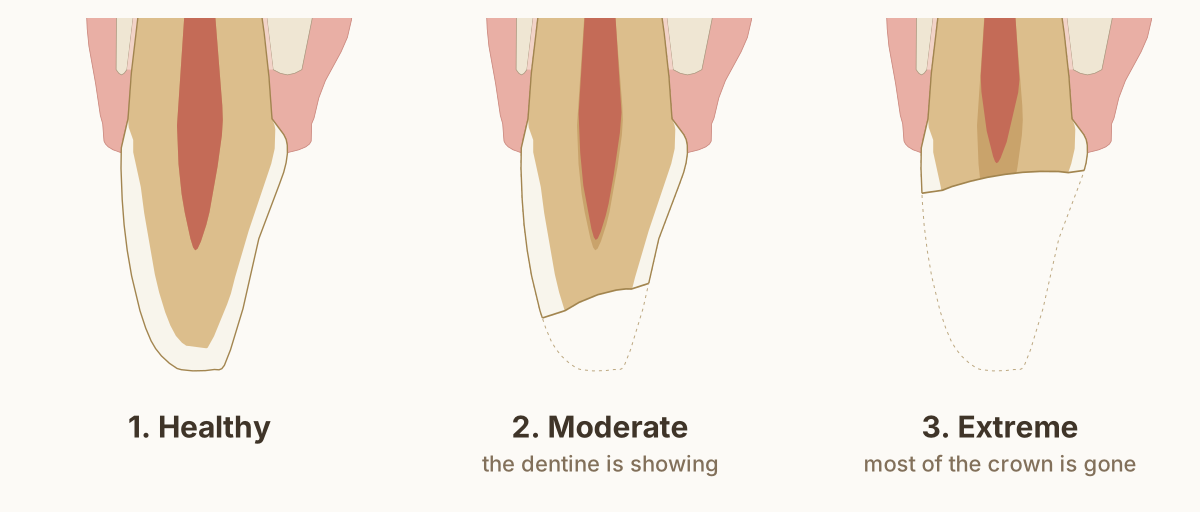
An upper front tooth at three stages: healthy; moderate wear with the dentine showing; and extreme wear with most of the crown gone. The dashed line is the tooth before the wear.

Teeth wear. That much is normal. But when wear is rapid, asymmetric, or acid-driven, it is pathological, and the cause needs finding. The distinction between physiological ageing and destructive wear is a clinical judgement, and catching it early is the difference between monitoring and a full rehabilitation. Most of the damage I see in practice could have been managed conservatively if it had been identified one stage sooner.

Dr. Khalid AletaibiWritten by Dr. Khalid Aletaibi, DHA-licensed dentist

QUICK ANSWER

Tooth wear has three mechanisms, attrition (grinding), erosion (acid dissolution), and abrasion (mechanical wear), and most clinical cases involve a combination [3]. The European consensus on severe tooth wear recommends a stepped approach: identify and control the cause first, monitor mild wear, and intervene conservatively with adhesive restorations only when structural integrity or function is threatened [1]. Early detection using standardised scoring systems like the Basic Erosive Wear Examination allows risk-based management before the damage requires complex treatment [2]. The European consensus statement on severe tooth wear goes further: it recommends delaying restorative intervention as long as possible, and taking a minimally invasive adhesive approach when treatment is finally agreed.

Approach

Stepped, cause first

First step

Find the cause

Tooth structure removed

Little, often only a bevel

Reversibility

Composite repairable

Maintenance

Ongoing

What tooth wear actually is, and why the cause matters more than the damage

Tooth wear, which many people first notice as teeth getting shorter or flatter, is the loss of tooth surface through three distinct mechanisms. Attrition is tooth-on-tooth contact, typically from grinding or clenching. Erosion is chemical dissolution by acid, from dietary sources like citrus and carbonated drinks, or from gastric acid in patients with reflux. Abrasion is mechanical wear from external sources, most commonly aggressive toothbrushing. Shellis and Addy's review of these interactions demonstrated that the three mechanisms rarely act in isolation: erosion softens the enamel surface, making it dramatically more vulnerable to attrition and abrasion, a synergy that accelerates wear far beyond what any single mechanism would produce alone [3].

This is why the clinical assessment begins not with measuring how much tooth has been lost, but with understanding why it was lost. A patient whose wear is driven primarily by nocturnal bruxism needs a different management strategy from a patient whose wear is driven by daily dietary acid exposure, even if the visible damage looks identical. Gastroesophageal reflux, in particular, is an underdiagnosed driver of erosive tooth wear, Lechien and colleagues' systematic review found a significant association between reflux disease and dental erosion, with many patients unaware of their reflux until the dental damage prompts investigation [5].

Grinding, acid and hard brushing, each shown alone on the same upper central incisor and lower first molar, with the biting surface beside each molar. Most people have a mix of these, and shape alone cannot prove the cause.

Diagram page and reuse terms: Three ways teeth wear, and the mark each one leaves

Sources and measurements
  • European consensus report on erosive tooth wear: attrition gives flat, sharp-bordered, glossy facets that match the opposing tooth; erosion gives flattening, cupping and concavities wider than deep, often with an intact rim at the gum margin; abrasion lies at the gum line, its upper part cutting into enamel at a right angle and its lower part running out onto the root. DOI 1, Three ways teeth wear, and the mark each one leaves
  • The grades: the Tooth Wear Evaluation System 2.0 grades the biting surface of a tooth by wear within the enamel, dentine exposed with up to a third of the crown's height lost, a third to two thirds lost, and two thirds or more. It also lists the signs of mechanical and chemical wear. No grading scale has been validated against measured tissue loss on a single tooth, so these drawings illustrate grades and do not measure them. DOI 2, Three ways teeth wear, and the mark each one leaves
  • An expert review: where attrition exposes dentine, it stays flat and in one plane with the enamel, and shiny, well-defined facets are a sign that it is active. DOI 3, Three ways teeth wear, and the mark each one leaves
  • Woelfel's Dental Anatomy: wear facets on the incisal edges of upper incisors slope cervically toward the palate. No study gives a facet angle, so none is printed here.
  • Lower first molars of young adults, scanned over three years: the load-bearing cusps wore most, in the order mesiobuccal, distobuccal, distal; lingual cusps were mostly faceted; and cupped lesions seemed to develop from facets. DOI 5, Three ways teeth wear, and the mark each one leaves
  • A review of erosion: in erosion the width of a smooth-surface defect clearly exceeds its depth; in brushing wear at the gum line, the depth exceeds the width. DOI 6, Three ways teeth wear, and the mark each one leaves
  • The shape of hollowed dentine, in buccolingual sections: depth was about a third of breadth in erosion (0.33) and about a sixth in abrasion (0.15 to 0.19). The groups also differed in ancestry. DOI 7, Three ways teeth wear, and the mark each one leaves
  • Hollows are not proof of acid: in one comparison, deep cupping of more than 0.5 mm was found in 78% of medieval skulls with an abrasive diet and 45% of people on an acidic diet, so cupping is the least certain sign of erosion in adults. DOI 8, Three ways teeth wear, and the mark each one leaves
  • With vomiting-associated eating disorders, the risk of erosive wear is mainly on the palatal surfaces of the incisors. DOI 9, Three ways teeth wear, and the mark each one leaves
  • Cervical lesions in 57 patients and 171 teeth: 91% had an axial depth of 1 to 2 mm and 46% were on premolars, first premolars most. DOI 10, Three ways teeth wear, and the mark each one leaves
  • A review: most authors now regard erosion as the most important factor in lesions at the gum line, so brushing is rarely the whole explanation. DOI 11, Three ways teeth wear, and the mark each one leaves
  • The teeth are the measured upper central incisor and lower first molar used in every figure on this site. How deep each worn surface, hollow and notch is drawn is representative, not a measurement of one patient.

A close-up of the buccal cusp of the molar in the stages figure, with a 1 mm scale. Hollows like this can come from grinding, from acid, or from both, and the tubules under the worn surface become sealed.

Diagram page and reuse terms: Worn dentine inside a rim of enamel

Sources and measurements
  • Hollows are not proof of acid: in one comparison, deep cupping of more than 0.5 mm was found in 78% of medieval skulls with an abrasive diet and 45% of people on an acidic diet, so cupping is the least certain sign of erosion in adults. DOI 1, Worn dentine inside a rim of enamel
  • Lower first molars of young adults, scanned over three years: the load-bearing cusps wore most, in the order mesiobuccal, distobuccal, distal; lingual cusps were mostly faceted; and cupped lesions seemed to develop from facets. DOI 2, Worn dentine inside a rim of enamel
  • The shape of hollowed dentine, in buccolingual sections: depth was about a third of breadth in erosion (0.33) and about a sixth in abrasion (0.15 to 0.19). The groups also differed in ancestry. DOI 3, Worn dentine inside a rim of enamel
  • Extracted molars with worn dentine: transparent and reactionary dentine were found only under attrition, with tubules partly or fully occluded and permeability reduced. The thickness of the band drawn here is representative. DOI 4, Worn dentine inside a rim of enamel
  • The teeth are the measured upper central incisor and lower first molar used in every figure on this site. How deep each worn surface, hollow and notch is drawn is representative, not a measurement of one patient.

How wear is measured and monitored, and when monitoring is enough

The Basic Erosive Wear Examination, introduced by Bartlett, Ganss, and Lussi, provides a standardised, reproducible scoring system that grades erosive wear on a four-point scale across all sextants of the mouth [2]. Its value is not in the score itself but in what it enables: risk stratification. A low BEWE score with an identifiable, controllable cause, a dietary acid habit, for example, can be managed with behaviour change, protective fluoride strategies, and serial monitoring rather than immediate restoration. A high score, or a score that is increasing between visits, signals that the wear is outpacing the body's protective mechanisms and that intervention is needed.

Prevalence data confirms that erosive tooth wear is not rare. Dallavilla and colleagues' systematic review of risk group patients, including those with gastric reflux, eating disorders, frequent acid exposure, and medication-related dry mouth, found erosive wear rates significantly higher than in the general population [4]. These patients benefit most from early, systematic screening, because a restoration does not stop wear: the European consensus notes that restorations change its rate, location and nature rather than prevent it [1].

For a single tooth, the Tooth Wear Evaluation System grades the biting surface by how much of the crown's height has gone: wear within the enamel, dentine showing with up to a third lost, between a third and two thirds lost, and two thirds or more [7]. The European consensus calls wear severe once at least a third of the crown has been lost [1]. How quickly a tooth moves through these grades varies widely between people, and between teeth in the same mouth [9]. On average, an upper central incisor is about 1 mm shorter by age 70 [8], and the European consensus puts a molar at about 1.7 mm over the same span [1], so wear well beyond that is more than age alone usually explains. No study has timed how long a tooth takes to pass from one grade to the next, which is why the explorer below moves through stages rather than years.

How tooth wear is managed, and why the European consensus changed the approach

The European consensus statement on the management of severe tooth wear, authored by Loomans, Opdam, Bartlett, and an international panel, established the stepped approach used today [1]. The consensus recommends three tiers: first, prevention and monitoring for mild wear where the cause can be controlled; second, conservative adhesive restorations, direct composite buildups, indirect composite or ceramic overlays, for moderate wear where function or structure is compromised; and third, indirect restorations with greater coverage only when the tooth structure is too diminished for adhesive approaches. At every tier, the principle is the same: do the least that achieves stability, and do not restore what can be monitored.

Direct composite resin, in particular, has become the first-line restorative material for managing tooth wear conservatively. Vajani, Tejani, and Milosevic's systematic review confirmed that direct composite performs reliably as both a definitive and a long-term transitional restoration in wear cases, with the added advantage that it can be repaired, adjusted, and added to without removing sound tooth structure [6]. This repairability is not a weakness, it is the material's greatest strength in a wear case, because wear management is an ongoing process, not a one-time fix. The teeth may need adjustment as the bite settles, and composite allows that without re-preparing the tooth. In a prospective study of 34 patients with severe wear, followed for a mean of more than five years, direct composite restorations failed at no more than 2.2% a year in front teeth and 2.9% a year in back teeth, and molars needed the most maintenance [10].

The most important intervention in tooth wear management is often not a restoration at all, it is identifying and controlling the cause. A night guard for a bruxist. Dietary counselling for a patient with high acid intake. A referral to a gastroenterologist for a patient with undiagnosed reflux. These steps do not appear on a treatment plan as line items, but without them, every restoration placed on a worn tooth is fighting a losing battle. The teeth I restore for wear last longest in the patients who understand what caused the damage and have taken steps to prevent it from recurring.

What a worn tooth actually needs depends on the case and on how far the wear has gone. When wear has reached the dentine and is causing problems, a composite filling is often enough, sometimes with nothing more than a short bevel to blend it into the enamel. When a third or more of the crown has gone, a veneer on a front tooth or a bonded ceramic overlay on a back tooth may be the better restoration. When the wear is severe and runs through the whole mouth, treatment becomes a full-mouth rehabilitation planned with smile design, the height of the bite may need raising, and the teeth are then restored in ceramics.

Four published grades of wear on an upper central incisor and a lower first molar, with the treatment each usually needs. Treatment depends on the whole mouth, and finding the cause comes first at every stage.

Diagram page and reuse terms: What each stage of wear usually needs

Sources and measurements
  • The grades: the Tooth Wear Evaluation System 2.0 grades the biting surface of a tooth by wear within the enamel, dentine exposed with up to a third of the crown's height lost, a third to two thirds lost, and two thirds or more. It also lists the signs of mechanical and chemical wear. No grading scale has been validated against measured tissue loss on a single tooth, so these drawings illustrate grades and do not measure them. DOI 1, What each stage of wear usually needs
  • European consensus on severe tooth wear: wear is severe once at least a third of the clinical crown has been lost; with no complaints, patients are monitored first; preparation is limited to what is necessary, such as seats, bevels or chamfers; and restorations change the rate, location and nature of wear rather than prevent it. DOI 2, What each stage of wear usually needs
  • Direct composite for severe wear: 34 patients and 1,269 restorations followed for a mean of 62.4 months, with annual failure rates of at most 2.2% in front teeth and 2.9% in back teeth; molars needed the most maintenance. DOI 3, What each stage of wear usually needs
  • The pulp: wear is usually slow and pulp death is rare, yet 11.6% of 448 patients referred for excessive wear had near or frank exposures or root canal treatment. No study gives, in millimetres, how far the human pulp draws back under wear, so the distance drawn is representative. DOI 4, What each stage of wear usually needs
  • Woelfel's Dental Anatomy: wear facets on the incisal edges of upper incisors slope cervically toward the palate. No study gives a facet angle, so none is printed here.
  • The teeth are the measured upper central incisor and lower first molar used in every figure on this site. How deep each worn surface, hollow and notch is drawn is representative, not a measurement of one patient.

A close-up of the worn edge of the front tooth in the stages figure, with a 1 mm scale. The bevel stays in the enamel, and the rest of the tooth's shape is added in composite.

Diagram page and reuse terms: A short bevel blends the composite in

Sources and measurements
  • European consensus on severe tooth wear: wear is severe once at least a third of the clinical crown has been lost; with no complaints, patients are monitored first; preparation is limited to what is necessary, such as seats, bevels or chamfers; and restorations change the rate, location and nature of wear rather than prevent it. DOI 1, A short bevel blends the composite in
  • Direct composite for severe wear: 34 patients and 1,269 restorations followed for a mean of 62.4 months, with annual failure rates of at most 2.2% in front teeth and 2.9% in back teeth; molars needed the most maintenance. DOI 2, A short bevel blends the composite in
  • The teeth are the measured upper central incisor and lower first molar used in every figure on this site. How deep each worn surface, hollow and notch is drawn is representative, not a measurement of one patient.

What each stage of wear usually needs

What each stage of wear usually needs
What has happenedWhat it usually needs
MildWear within the enamel onlyFinding the cause and monitoring; no restoration
ModerateDentine showing, with up to a third of the crown's height lostMonitoring if nothing is bothering you; otherwise often composite, sometimes blended with only a short bevel
SevereA third to two thirds of the crown's height lostDepending on the case, a veneer on a front tooth or a bonded ceramic overlay on a back tooth
ExtremeTwo thirds or more of the crown's height lostCeramics over a composite core; when the wear is generalised, a full-mouth plan with smile design, raising the bite if needed

What happens, step by step

  1. 1

    We grade the wear

    We score the wear with a standardised system and, when useful, photographs so we can tell stable wear from wear that is still progressing.

  2. 2

    We find the cause

    We look for the real driver, grinding, dietary acid, reflux, or hard brushing, because the cause guides everything that follows.

  3. 3

    We control the cause

    We address the driver first with a night guard, dietary changes, or a referral, so any later restoration is not fighting an active process.

  4. 4

    We monitor or restore

    Mild, stable wear is monitored over time, while wear that threatens function or structure is rebuilt according to how far it has gone: composite blended with a bevel, a veneer or a ceramic overlay, or, when it runs through the whole mouth, a full-mouth plan.

  5. 5

    We review over time

    We reassess the bite and the restorations at follow-ups, adjusting or adding composite without re-preparing the tooth.

Conservative profile

  • Cause control firstHigh
  • Tooth structure preservedHigh
  • How invasiveLow
  • Ongoing monitoring neededMedium

COMMON QUESTIONS

What patients ask most.

How do I know if my tooth wear is normal or a problem?
Some flattening of the biting surfaces over decades is physiological and expected. Wear that is rapid, uneven, associated with sensitivity, or that has exposed the darker dentine underneath the enamel is likely pathological. I assess this during your examination using a standardised scoring system and, when needed, serial photographs to track whether the wear is progressing. If it is stable and mild, monitoring is appropriate. If it is progressing, we need to understand the cause and act before the damage becomes complex to repair.
Can acidic food and drink really damage my teeth?
Yes, and more easily than most patients expect. Citrus fruits, vinegar-based dressings, carbonated drinks, including sparkling water, and sports drinks all have a pH low enough to dissolve enamel over time. The damage is cumulative and often painless until it is advanced. Frequency matters more than quantity: sipping an acidic drink throughout the day is far more damaging than drinking it with a meal. Simple changes, reducing frequency, using a straw, rinsing with water after acidic foods, can significantly slow the process.
I grind my teeth. Will that cause wear?
Grinding, bruxism, is one of the primary causes of attritive tooth wear. The forces involved in nocturnal grinding can be many times greater than normal chewing forces, and over years they flatten the biting surfaces, chip enamel, and fracture restorations. A well-fitted night guard spreads the load and keeps tooth from grinding directly on tooth, although trials have not yet measured how much it slows wear. But the guard alone does not address the underlying cause, which may involve stress, sleep quality, airway issues, or medications. I assess all of these as part of the management.
Can worn teeth be repaired without crowns?
In many cases, yes. Direct composite bonding can rebuild worn surfaces by adding material to what remains of the tooth, rather than cutting the tooth down further for a crown. This keeps almost all of the remaining tooth, often with only a short bevel cut at the edge, and it can be repaired if it chips or wears over time. When more has been lost, a veneer or a ceramic overlay may be the better restoration, and when the wear is severe and runs through the whole mouth, treatment becomes a full-mouth plan.
Does tooth wear always get worse?
Not necessarily. If the cause is identified and controlled, bruxism managed with a guard, dietary acid reduced, reflux treated, wear can stabilise. The key is early identification and monitoring. Studies suggest wear often comes in phases rather than at a steady pace, and wear that has been stable for years rarely needs restoration. Wear that is progressing despite conservative measures needs intervention before it reaches a stage that requires complex treatment. This is why regular examination and documentation of wear patterns matters.
How fast do teeth wear down?
It varies widely. On average an upper front tooth is about 1 mm shorter by age 70, which is slow. Some people wear much faster, teeth in the same mouth can behave differently, and wear often comes in phases. There is no reliable timetable, which is why I compare photographs or scans over time rather than predicting from one visit.
Should I stop brushing so hard?
Aggressive brushing with a hard-bristled brush is a recognised cause of abrasive wear, particularly at the gum line where the enamel is thinnest. A soft-bristled brush with gentle pressure is effective at removing plaque without damaging the tooth surface. Timing also matters: brushing immediately after consuming acidic food or drink, when the enamel is temporarily softened, can accelerate wear. Waiting twenty to thirty minutes, or rinsing with water first, reduces this risk considerably.

Speak to us

Would you prefer we call you?

Leave your name and number and Dr. Khalid's team will call you back to answer your questions and find a time that suits you.

Concerned about tooth wear?

If your teeth are visibly shorter, more sensitive, or showing yellow dentine through thinning enamel, let's assess the cause and the severity before it progresses further.

Book a Consultation

← Functional Dentistry

Call Dr. Khalid directlyDiscuss your concerns and questions