Measured diagram
Is air polishing safe for fillings and crowns?
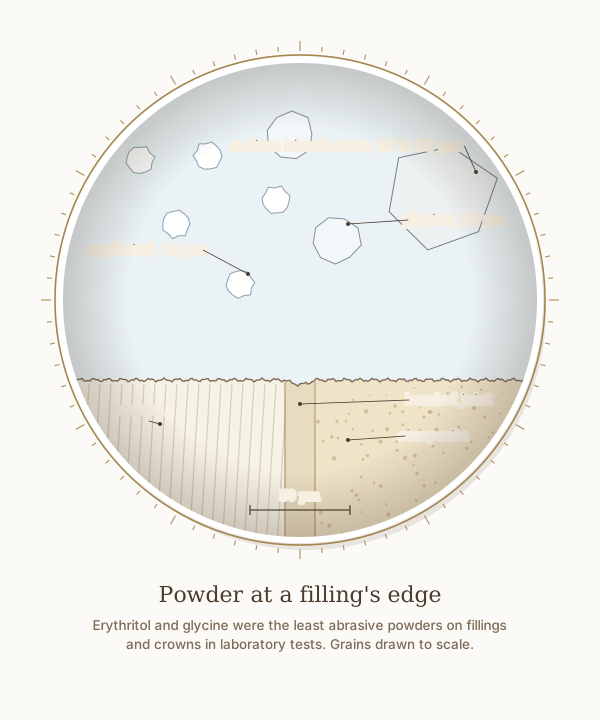
Grains drawn to scale beside a 15 micrometre bonded joint, with a 50 micrometre scale. Erythritol and glycine were the least abrasive powders on fillings and crowns in laboratory tests; grain size alone is not the reason.
What the drawing is measured from
- Powders and restorations: across 42 laboratory studies, erythritol and glycine were the least abrasive powders on fillings and crowns, while sodium bicarbonate and calcium carbonate roughened them more. DOI 1
- Grain size is not what makes a powder gentle: within glycine, the larger 65 micrometre grains did less damage than the 25 micrometre ones (Tada 2011). Grain sizes from the maker's table: erythritol about 14, glycine 25 or 65, sodium bicarbonate 40 or 65 micrometres. DOI 2
- The bonded joint: in a laboratory study of composite restorations through four cleaning cycles, sodium bicarbonate deepened the joint's roughness from 12.7 to 22.3 micrometres, while erythritol changed it little (15.4 to 17.3). DOI 3
Use this diagram
Free to use, including commercially, with credit.
This diagram is published under CC BY 4.0. You may reproduce it in articles, teaching material, presentations and patient information, print or online, without asking. The one condition is that you credit Dr. Khalid Aletaibi and link back to this page.
It is published this way on purpose. The measurement in this drawing is not something the people selling the treatment tend to publish, so it is more useful spread than kept.
Credit line
Powder at a filling's edge. Dr. Khalid Aletaibi, CC BY 4.0. https://khalidaletaibi.com/en/diagrams/dental-cleaning-powder
HTML embed
<figure>
  <img src="https://khalidaletaibi.com/figures/dental-cleaning-powder-en.svg" alt="Powder at a filling's edge" width="100%">
  <figcaption>
    Powder at a filling's edge. <a href="https://khalidaletaibi.com/en/diagrams/dental-cleaning-powder">Dr. Khalid Aletaibi</a>,
    <a href="https://creativecommons.org/licenses/by/4.0/">CC BY 4.0</a>
  </figcaption>
</figure>