Skip to content
Dr. Khalid AletaibiConservative Dentistry · Dubai

CONSERVATIVE COSMETIC

Bonding, before you commit to veneers.

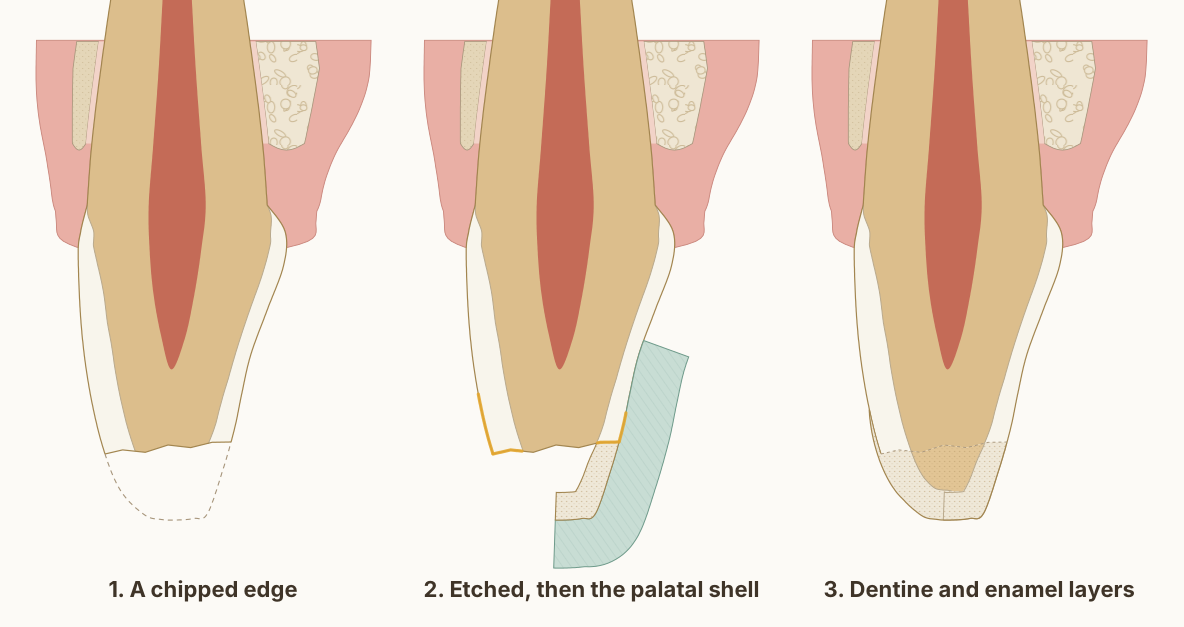
Three stages of bonding a chipped upper front tooth: the chipped edge with the lost part dashed, then the enamel etched and a palatal shell formed against a silicone key, then dentine and enamel layers rebuilding the edge.

A small chip on a front tooth, a gap between the central incisors, a worn incisal edge, direct composite bonding fixes all of these in a single appointment, with no enamel removed and no laboratory step. It is the conservative, minimally invasive answer to a cosmetic complaint, and the one worth trying before anything irreversible. The result is reversible, repairable, and designed to be re-done in twenty years rather than re-cut every ten.

Dr. Khalid AletaibiWritten by Dr. Khalid Aletaibi, DHA-licensed dentist

QUICK ANSWER

Composite bonding is the direct restoration of front teeth with tooth-coloured resin, sculpted and cured chairside in a single visit. Edge bonding is its smallest form: composite added only along the biting edges to repair chips and wear or even out the length of the teeth. There is little or no preparation of the underlying enamel. That makes it the conservative, minimally invasive option among cosmetic treatments, and unlike a veneer it can usually be repaired, added to, or removed without cost to the tooth. Recent systematic reviews of anterior composites report annual failure rates around 1-3% per year, with many restorations lasting well over a decade. The biggest advantage over veneers is not speed, it is reversibility: nothing has been cut away, so the original tooth is still there if anything ever needs to change.

Visits

Single visit

Anaesthetic

Often none

Tooth removed

Little to none

Reversibility

Reversible

Longevity

Over a decade

What bonding actually is, and why it stays conservative

Composite bonding is the direct, freehand restoration of teeth with a light-cured resin; when it covers the whole front of a tooth, it is often called a composite veneer. The dentist conditions the enamel, applies an adhesive, and then layers and sculpts the composite into shape against the tooth itself, no impression, no laboratory step, no temporary. The entire restoration is built and finished in a single appointment. Crucially, the underlying tooth is not cut to make room for it. The bonding sits on top of the existing enamel rather than replacing a layer that has been removed.

This is the conservative principle in its purest form. Edelhoff and Sorensen quantified exactly how much sound tooth structure different preparation designs sacrifice [6], and their tables run from veneer preparations through partial coverage to full crowns, each one removing more enamel and dentine than the last. Bonding does not appear on those tables, because there is nothing to subtract. When the indication is right, it is the only cosmetic restoration where the tooth's original structure is left intact and the tissue can simply be added to.

The same upper central incisor in every panel, cut from the lip side to the palate side, with the gum, ligament and bone around it. The tooth and the tissues at its neck are drawn to published measurements; the break, the etched enamel, the key and the layers show what typically happens, not one patient's tooth.

Diagram page and reuse terms: Bonding a chipped front tooth: nothing cut, the lost enamel and dentine rebuilt in layers

Sources and measurements
  • The rebuild follows two principles from one textbook. The additive principle: in a direct restoration the etching and bonding are extended beyond the defect onto intact enamel, to blend and reinforce the restoration; its example is a small chipped edge restored without preparation: the tooth was etched, bonded and restored well beyond the fracture line under rubber dam. And natural guided stratification: a silicone index made from a wax-up or mock-up holds a palatal shell of enamel-like material, dentine-like increments are placed where the natural dentine was, and the last increment is the labial enamel. Magne and Belser 2022, Biomimetic Restorative Dentistry, volume 1, pages 319, 330 and 331.
  • In 455 crown-fractured permanent incisors followed for a mean of 2.3 years and up to 17, the pulp survived in 99 per cent of teeth the injury had not also loosened or displaced, and in none of them did it die; when the tooth had also been loosened, pulp death in fractures through enamel and dentine, like this one, rose from 0 to 28 per cent. Robertson et al. 2000, International Journal of Paediatric Dentistry. DOI 2, Bonding a chipped front tooth: nothing cut, the lost enamel and dentine rebuilt in layers
  • A 2024 German clinical guideline on direct composite restorations, agreed by strong consensus, recommends etching the enamel of every direct composite restoration with phosphoric acid, to improve the long-term quality of the enamel margin and prevent discoloration there. It finds both rubber dam and other isolation workable, with rubber dam possibly helping restorations last longer. These process recommendations are consensus-based. Sekundo et al. 2024, The Journal of Adhesive Dentistry, part 2. DOI 3, Bonding a chipped front tooth: nothing cut, the lost enamel and dentine rebuilt in layers
  • Acid on the enamel only, before a universal adhesive: in a randomised trial of 295 back-tooth fillings in 70 patients, fillings bonded this way showed significantly fewer defects at their edges after 24 months than those bonded with the adhesive alone. Barceleiro et al. 2023, Journal of Applied Oral Science. DOI 4, Bonding a chipped front tooth: nothing cut, the lost enamel and dentine rebuilt in layers
  • In fillings at the necks of teeth, a meta-analysis of 10 randomised trials found less staining and fewer adaptation defects at the edges when the enamel was etched selectively before a self-etch adhesive, and fewer fillings lost at three years. Szesz et al. 2016, Journal of Dentistry, systematic review and meta-analysis. DOI 5, Bonding a chipped front tooth: nothing cut, the lost enamel and dentine rebuilt in layers
  • A Cochrane review of six randomised trials with 1,342 participants found low-certainty evidence that rubber dam may lower the failure rate of fillings compared with cotton rolls at six months, and very uncertain evidence at other times; all the trials were at high risk of bias, and the results came from fillings at the necks of teeth and in children's back teeth. Miao et al. 2021, Cochrane Database of Systematic Reviews. DOI 6, Bonding a chipped front tooth: nothing cut, the lost enamel and dentine rebuilt in layers
  • A meta-analysis of 21 prospective clinical trials of front-tooth composites estimated that 90 per cent of Class IV restorations, which rebuild a broken corner or edge of a front tooth, last 10 years without being replaced; bulk fracture was the main reason for replacement, more often with microfilled composites. Twelve of the trials started before 1991. Heintze, Rousson and Hickel 2015, Dental Materials. DOI 7, Bonding a chipped front tooth: nothing cut, the lost enamel and dentine rebuilt in layers
  • A critical appraisal of clinical and laboratory publications: a bevel on the enamel margin was traditionally placed for retention and a gradual colour transition, but modern adhesives, composites and technique make adequate front-tooth composites possible without one, with a more conservative preparation, a smaller restored surface and more tooth kept when the restoration is redone. Baratieri and Ritter 2005, Journal of Esthetic and Restorative Dentistry. DOI 8, Bonding a chipped front tooth: nothing cut, the lost enamel and dentine rebuilt in layers
  • The steps are drawn as Dr. Khalid works: nothing is cut, not even a bevel; the work is done under rubber dam; phosphoric acid goes on the enamel only, past the break, before the adhesive; a silicone key made from a wax-up or mock-up of the agreed shape guides the palatal enamel shell; then dentine shades go where the tooth's own dentine was, and a last enamel layer rebuilds the front and runs a little onto intact enamel. The level and line of the break are illustrative, the shell follows the drawing's palatal enamel, and the layers are drawn to the tooth's own enamel and dentine.
  • Labial enamel thickness at 1, 3 and 5 mm above the cementoenamel junction: 0.48, 0.81 and 0.95 mm. Cone-beam CT of 1,600 maxillary central incisors in patients aged 18 to 40, Diagnostics 2024, PMC11592583. In agreement with micro-CT of 20 central incisors, which found a range of 0.461 to 0.966 mm. Enamel also thins significantly with age, so these are not lifetime values. DOI 10, Bonding a chipped front tooth: nothing cut, the lost enamel and dentine rebuilt in layers
  • Pulp distances measured on cone-beam CT across 200 teeth: palatal fossa to the pulp chamber 2.21 mm, incisal edge to the pulp 5.02 mm. Kohok et al. 2025, PMID 41193532. PubMed 11, Bonding a chipped front tooth: nothing cut, the lost enamel and dentine rebuilt in layers
  • Two things on this drawing are anatomically representative but are not taken from published measurements, and are therefore not labelled with a number: the palatal enamel profile, and the width of the pulp space. Only the labelled values are sourced.
  • The tooth follows Wheeler's measurements for the upper central incisor: crown 10.5 mm, root 13.0 mm, 7.0 mm labiolingually at the crown and 6.0 mm at the cervix, with the crests of contour in the cervical third. Nelson, Wheeler's Dental Anatomy, Physiology and Occlusion, 11th edition, Table 6.1.
  • At the upper central incisors of 88 periodontally healthy adults, the gum overlapped the enamel by 1.41 mm, the bone crest lay 2.05 mm from the cementoenamel junction, the free gingiva was 1.12 mm thick at its base and the bone 0.45 mm thick at the crest. Alpiste-Illueca 2004, The International Journal of Periodontics and Restorative Dentistry. PubMed 14, Bonding a chipped front tooth: nothing cut, the lost enamel and dentine rebuilt in layers
  • Cone-beam CT of 120 people measured the labial bone over upper central incisors at 0.73, 0.69 and 0.60 mm in the coronal, middle and apical thirds, with the palatal bone significantly thicker. AlTarawneh et al. 2018, Journal of Prosthodontics. DOI 15, Bonding a chipped front tooth: nothing cut, the lost enamel and dentine rebuilt in layers

What the longevity data shows

The most-cited modern systematic review on anterior composites is the Demarco 2015 paper, which pooled clinical studies on direct anterior restorations and reported annual failure rates that, in well-controlled studies, fall in the 1-3% per year range, translating to median survival figures comparable to many indirect alternatives [1]. The dominant failure modes were not catastrophic fracture but discolouration of the margin, marginal staining, and small chipping that can usually be repaired chairside rather than replaced. The Frese multicenter long-term trial of direct composite buildups in the anterior dentition added prospective clinical data that confirmed these survival numbers in current-generation materials [2].

Two studies are particularly relevant to the cosmetic indications most patients ask about. Lempel and colleagues followed direct composite restorations placed for fractured maxillary teeth and diastema closure for seven years, and reported survival figures that justified direct composite as a definitive, not provisional, restoration for those exact use cases [3]. The Hofsteenge group then extended the longevity question well beyond a decade, reporting a mean fifteen-year follow-up of extensive direct composite restorations placed after amalgam replacement, with survival data that puts to rest the old assumption that direct composite is inherently a short-term solution [5].

A close-up of the lip side of the chipped incisor in the step-by-step figure, with a 1 mm scale. The break is not bevelled: acid goes on the enamel past it and on its enamel rim, the adhesive covers enamel and dentine alike, and the last enamel layer runs about 1.5 mm onto intact enamel, thinning to nothing so the join blends in.

Diagram page and reuse terms: Where the bonding meets the tooth

Sources and measurements
  • The rebuild follows two principles from one textbook. The additive principle: in a direct restoration the etching and bonding are extended beyond the defect onto intact enamel, to blend and reinforce the restoration; its example is a small chipped edge restored without preparation: the tooth was etched, bonded and restored well beyond the fracture line under rubber dam. And natural guided stratification: a silicone index made from a wax-up or mock-up holds a palatal shell of enamel-like material, dentine-like increments are placed where the natural dentine was, and the last increment is the labial enamel. Magne and Belser 2022, Biomimetic Restorative Dentistry, volume 1, pages 319, 330 and 331.
  • A critical appraisal of clinical and laboratory publications: a bevel on the enamel margin was traditionally placed for retention and a gradual colour transition, but modern adhesives, composites and technique make adequate front-tooth composites possible without one, with a more conservative preparation, a smaller restored surface and more tooth kept when the restoration is redone. Baratieri and Ritter 2005, Journal of Esthetic and Restorative Dentistry. DOI 2, Where the bonding meets the tooth
  • A 2024 German clinical guideline on direct composite restorations, agreed by strong consensus, recommends etching the enamel of every direct composite restoration with phosphoric acid, to improve the long-term quality of the enamel margin and prevent discoloration there. It finds both rubber dam and other isolation workable, with rubber dam possibly helping restorations last longer. These process recommendations are consensus-based. Sekundo et al. 2024, The Journal of Adhesive Dentistry, part 2. DOI 3, Where the bonding meets the tooth
  • Acid on the enamel only, before a universal adhesive: in a randomised trial of 295 back-tooth fillings in 70 patients, fillings bonded this way showed significantly fewer defects at their edges after 24 months than those bonded with the adhesive alone. Barceleiro et al. 2023, Journal of Applied Oral Science. DOI 4, Where the bonding meets the tooth
  • In fillings at the necks of teeth, a meta-analysis of 10 randomised trials found less staining and fewer adaptation defects at the edges when the enamel was etched selectively before a self-etch adhesive, and fewer fillings lost at three years. Szesz et al. 2016, Journal of Dentistry, systematic review and meta-analysis. DOI 5, Where the bonding meets the tooth
  • Drawn as Dr. Khalid bonds a chipped edge: nothing is cut, not even a bevel; phosphoric acid goes on the enamel only, under rubber dam; then the adhesive over enamel and dentine, and a last layer that runs past the break onto intact enamel. The etched band and the adhesive are drawn wider than life so they can be seen; their widths are not measurements, and the length and thickness of the last layer are illustrative.
  • In a laboratory study on the ground enamel of 45 upper central incisors, phosphoric acid dissolved from about 3.5 micrometres of enamel (5 per cent acid for 15 seconds) to 27 micrometres (37 per cent acid for 60 seconds), so in life the etched band is far thinner than a drawing can show. Legler, Retief and Bradley 1990, American Journal of Orthodontics and Dentofacial Orthopedics. DOI 7, Where the bonding meets the tooth
  • In 105 fillings at the necks of teeth followed for a year, the few edges that discoloured were put down to composite left on enamel that had not been etched; here the acid reaches past where the last layer ends. Burrow and Tyas 1999, American Journal of Dentistry. PubMed 8, Where the bonding meets the tooth

When bonding is the right answer: and when it isn't

The 2024 evidence-based clinical practice guideline from the German adhesive dentistry working group is the most recent authoritative review of where direct composite is indicated, and it is unambiguous about the breadth of the use case: minor chips and fractures, anterior diastema closure, peg-shaped or undersized lateral incisors, incisal-edge wear, recontouring of mildly malformed teeth, and small to medium cavities in any tooth in the mouth [4]. For all of these, modern direct composite is a defensible first choice. It is also the natural starting point for the conservative ladder, try the smallest, most reversible answer first and only escalate if the result is genuinely not adequate.

There are situations where bonding is genuinely not the right answer, and being honest about them is part of the conservative position. Severe intrinsic discolouration that does not respond to whitening, large bulk loss across multiple teeth, heavy parafunctional habits that put the bonding under repeated bite-edge loading, or a smile design that requires a coordinated change across six or eight teeth at once, in those cases an indirect ceramic restoration is often the more durable answer. The conservative principle is not 'bonding always.' It is 'bonding first, escalate only when there is a good reason.' The right cosmetic restoration is the smallest one that solves the problem.

A close-up of the rebuilt edge from the step-by-step figure, with a 1 mm scale. The palatal shell came first, formed against the silicone key where the tooth's palatal enamel was; the dentine shades follow the tooth's own dentine; and the front enamel layer completes the front and the edge. The dashed line is the break they replace.

Diagram page and reuse terms: Inside the rebuilt edge

Sources and measurements
  • The rebuild follows two principles from one textbook. The additive principle: in a direct restoration the etching and bonding are extended beyond the defect onto intact enamel, to blend and reinforce the restoration; its example is a small chipped edge restored without preparation: the tooth was etched, bonded and restored well beyond the fracture line under rubber dam. And natural guided stratification: a silicone index made from a wax-up or mock-up holds a palatal shell of enamel-like material, dentine-like increments are placed where the natural dentine was, and the last increment is the labial enamel. Magne and Belser 2022, Biomimetic Restorative Dentistry, volume 1, pages 319, 330 and 331.
  • Drawn as Dr. Khalid layers a chipped edge: a palatal shell against a silicone key made from a wax-up or mock-up of the agreed shape, then dentine shades where the tooth's dentine was, then a front enamel layer. The shell follows the drawing's own palatal enamel, as no published thickness exists for it, and the level and line of the break are illustrative.
  • Labial enamel thickness at 1, 3 and 5 mm above the cementoenamel junction: 0.48, 0.81 and 0.95 mm. Cone-beam CT of 1,600 maxillary central incisors in patients aged 18 to 40, Diagnostics 2024, PMC11592583. In agreement with micro-CT of 20 central incisors, which found a range of 0.461 to 0.966 mm. Enamel also thins significantly with age, so these are not lifetime values. DOI 3, Inside the rebuilt edge
  • Two things on this drawing are anatomically representative but are not taken from published measurements, and are therefore not labelled with a number: the palatal enamel profile, and the width of the pulp space. Only the labelled values are sourced.

What happens, step by step

  1. 1

    We ask the smallest-restoration question

    First we examine the tooth and the bite to confirm bonding is the most conservative answer for your specific concern.

  2. 2

    We match the shade

    We choose a tooth-coloured resin that blends with your natural enamel before any work begins.

  3. 3

    We condition the enamel

    The surface is gently conditioned and an adhesive is applied, with little or no cutting of the tooth.

  4. 4

    We layer and sculpt

    The composite is built up directly on the tooth and light-cured, then shaped to restore the chip, gap, or worn edge.

  5. 5

    We polish and review

    The restoration is finished and polished in the same appointment, and can be refreshed chairside in future.

Conservative profile

  • How invasiveLow
  • Healthy tooth preservedHigh
  • Reversible if you change your mindHigh
  • Repairable chairsideHigh

COMMON QUESTIONS

What patients ask most.

Will composite bonding stain over time?
Modern micro-hybrid and nano-hybrid composites resist staining far better than the older materials patients sometimes remember. The most common cause of visible discolouration is not the composite body itself but the marginal interface between the composite and the underlying enamel, and that can usually be polished or refreshed chairside without replacing the restoration. Coffee, tea, red wine, and curry can still cause some surface staining over years; a routine polish at hygiene visits is usually enough to address it.
How long will my bonding last?
In a systematic review of anterior composite restorations, annual failure rates ranged from 0 to about 4% a year.[1] A multicentre study of 667 composite build-ups on front teeth found 91.7% still in place at 10 years and 77.6% at 15, and most of the problems along the way were chips that were repaired rather than replaced.[2] For comparison, a systematic review of porcelain veneers estimated about 95% survival at 10 years,[7] so the practical difference is less about lifespan than about upkeep: porcelain keeps its polish and colour longer, while bonding is easier to repair and redoing it costs the tooth little or nothing. The honest answer is that bonding is not 'temporary' the way some patients have been told; it can be a definitive long-term restoration when the indication and the technique are right. Its upkeep fits into routine care: at your check-up and cleaning, set at 4, 6 or 12 months for you, the edges are checked and cleaned, surface stain is lifted, and any chip can be repaired early, while it is still small. What happens at a cleaning is set out in your cleaning, step by step.
Can bonding fix gaps between my front teeth?
Yes, and the long-term data on this specific use case is good. Direct composite is one of the most conservative ways to close a small midline diastema or a series of small interdental spaces in the upper front teeth. The result is reversible: if you ever decide you want the gap back, the composite can be removed and the original enamel is still there. For larger gaps or for cases where the surrounding teeth would also need adjustment, a brief orthodontic alignment first is sometimes the more elegant answer.
What is edge bonding?
Edge bonding means adding tooth-coloured composite only to the biting edges of the front teeth, to rebuild a small chip, replace edges that have worn down, or make uneven teeth look the same length. It usually needs little or no drilling and often no anaesthetic, because the composite bonds to the enamel that is already there. In a systematic review of front-tooth composite restorations, fracture of the tooth or the restoration was the most common reason for failure, and restorations on worn teeth were among those studied,[1] so if the edges are wearing because of grinding, that habit is addressed as part of the plan, often with a night guard.
How is bonding actually different from veneers?
The difference that matters most is biological. Veneers require enamel to be removed from the front of the tooth so that the ceramic shell can be cemented in its place. Bonding does not. That distinction matters for the rest of your life, not just for the day of the appointment, because once enamel has been removed it cannot be added back. Ceramic does hold its polish and resist staining better over the years, and that is the trade-off in the other direction, but it is a trade-off paid for in tooth structure that does not come back.
Can bonding be repaired or redone later?
Yes, and this is one of the most underrated advantages of direct composite. A small chip in the corner of a bonding restoration can usually be polished away or refreshed with a tiny addition, all in the same appointment, without removing or replacing the rest of the work. Even when a full re-do is eventually needed after many years, the underlying tooth is still intact and the new restoration starts from the same conservative baseline as the first one. Ceramic veneers do not offer this, when one chips badly, the entire veneer typically has to be replaced.
How do I know if bonding is right for me specifically?
By having an honest examination that asks the right question first: what is the smallest restoration that would actually solve the cosmetic concern? If the answer is 'a chip on one tooth,' or 'a small gap,' or 'a worn edge,' bonding is almost always the conservative starting point. If the answer involves multiple teeth, large bulk loss, severe intrinsic discolouration, or a coordinated full smile design, the conversation legitimately moves to other options. The right answer is what the specific tooth and the specific bite call for, not what is fashionable.

Speak to us

Would you prefer we call you?

Leave your name and number and Dr. Khalid's team will call you back to answer your questions and find a time that suits you.

Considering veneers? Read this first.

Sometimes a chip, a gap, or a worn edge needs nothing more than a single visit and a thin layer of composite. We will examine your specific situation and tell you whether bonding is enough, or whether something else is genuinely needed.

Book a Consultation

← Conservative Cosmetic & Smile Design

Call Dr. Khalid directlyDiscuss your concerns and questions