Measured diagram
How deep is my decay, and what treatment does each depth need?
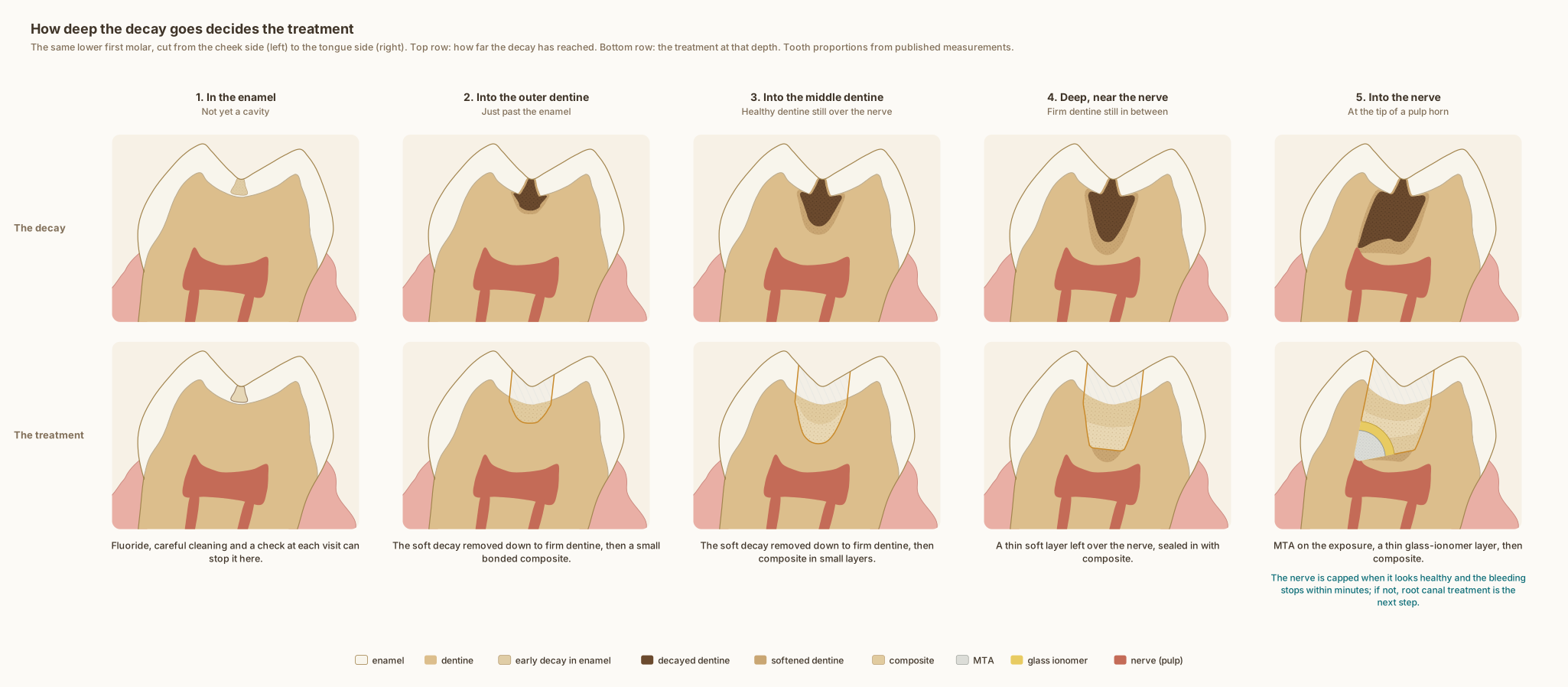
Five drawings of the same measured lower molar, the decay reaching a little deeper each time. In the enamel it can be stopped with fluoride, careful cleaning and a check at each visit. In the outer and middle dentine the soft decay is removed down to firm dentine and the tooth is rebuilt with bonded composite in small layers. Near the nerve a thin soft layer is left over it and sealed in. When the decay has reached the nerve, the exposure is capped with MTA and a thin glass-ionomer layer before the filling.
What the drawing is measured from
- In deep lesions in teeth with healthy pulps, international consensus recommends selective removal to soft dentine: decayed dentine close to the pulp does not need to be removed, and the priorities are keeping healthy tooth tissue, achieving a seal and keeping the pulp healthy. Schwendicke et al. 2016, Advances in Dental Research, International Caries Consensus Collaboration. DOI 1
- Decay is called deep when it reaches the inner quarter of the dentine but still leaves a protective layer of hard or firm dentine over the pulp: the European Society of Endodontology's definition, restated in the 2026 S3-level guideline on deep caries from European dental societies. The guideline supports selective or stepwise removal over complete removal, to lower the risk of exposing the pulp, and with selective removal the dentine at the edges is still cleaned to hard, for a secure restoration. Schwendicke et al. 2026, Clinical Oral Investigations. DOI 2
- The decay's shape follows the textbook drawing of decay in a groove: small at the surface, widening toward the junction with the dentine, then wider in the dentine and on toward the pulp. Woelfel's Dental Anatomy, Figure 10-1.
- The decay is drawn as two zones, the two layers of carious dentine often called infected and affected dentine. In the outer layer the cross-links that hold the dentine's collagen together were irreversibly destroyed; in the inner layer the change was considered reversible. Kuboki, Ohgushi and Fusayama 1977, Journal of Dental Research, laboratory study. How far each zone reaches in the drawing is illustrative, not measured. DOI 4
- When the decay has reached the pulp, the European Society of Endodontology advises working under rubber dam, stopping the bleeding with sodium hypochlorite or chlorhexidine, placing a calcium silicate cement such as MTA directly on the pulp and then the final restoration, with reviews at 6 and 12 months and then yearly for up to four years. Duncan et al. 2019, International Endodontic Journal, position statement. DOI 5
- In a randomised trial of direct pulp capping in premolars, MTA was placed as a layer 1.5 to 2 mm thick over the exposed pulp, reaching 0.5 to 1 mm beyond the exposure; every tooth stayed vital, and cone-beam CT measured the new dentine that formed over 9 to 16 weeks. Bui and Pham 2026, International Journal of Dentistry. DOI 6
- Drawn as Dr. Khalid works: rubber dam on every filling, composite in small layers bonded with selective enamel etch, the soft layer over the nerve sealed in with no liner, and, where the nerve is exposed, MTA covered with a thin layer of glass ionomer. Each lesion's depth follows the definitions above; the shapes are illustrative.
Use this diagram
Free to use, including commercially, with credit.
This diagram is published under CC BY 4.0. You may reproduce it in articles, teaching material, presentations and patient information, print or online, without asking. The one condition is that you credit Dr. Khalid Aletaibi and link back to this page.
It is published this way on purpose. The measurement in this drawing is not something the people selling the treatment tend to publish, so it is more useful spread than kept.
Credit line
How deep the decay goes decides the treatment. Dr. Khalid Aletaibi, CC BY 4.0. https://khalidaletaibi.com/en/diagrams/composite-filling-depths
HTML embed
<figure>
  <img src="https://khalidaletaibi.com/figures/composite-filling-depths-en.svg" alt="How deep the decay goes decides the treatment" width="100%">
  <figcaption>
    How deep the decay goes decides the treatment. <a href="https://khalidaletaibi.com/en/diagrams/composite-filling-depths">Dr. Khalid Aletaibi</a>,
    <a href="https://creativecommons.org/licenses/by/4.0/">CC BY 4.0</a>
  </figcaption>
</figure>