Measured diagram
How does a crown bond to a root-filled tooth?
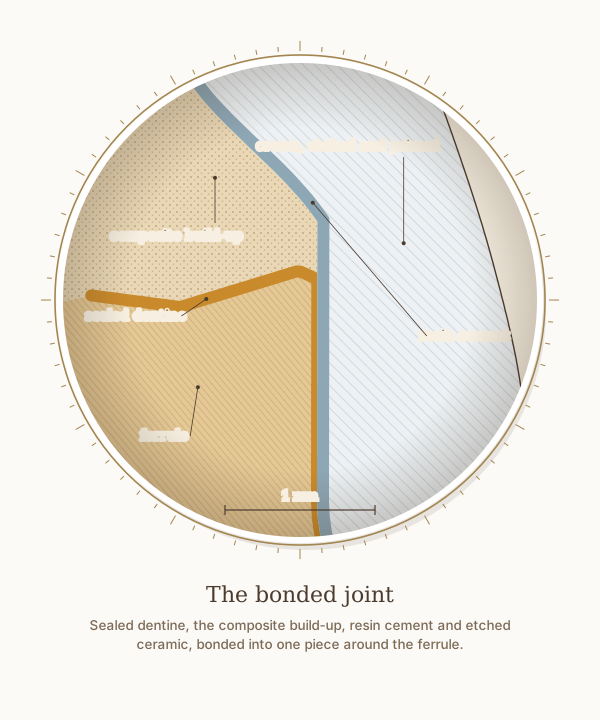
A close-up where the remaining wall meets the build-up, from the same measured molar as the step-by-step figure, with a 1 mm scale. The freshly cut dentine was sealed straight away, the build-up was bonded over it, and the etched and primed crown was bonded to both with resin cement.
What the drawing is measured from
- Immediate dentine sealing means applying and curing a dentine bonding agent on the freshly cut dentine straight after the preparation, before the impression or scan; a review of more than 30 articles found that it appears to give better bond strength, fewer gaps, less bacterial leakage and less sensitivity. Magne 2005, Journal of Esthetic and Restorative Dentistry, review. DOI
- In 15 extracted molars, dentine sealed immediately after preparation bonded at 58.25 MPa, as strongly as dentine bonded directly (55.06 MPa), while dentine sealed only at the cementation visit bonded at 11.58 MPa. Magne et al. 2005, The Journal of Prosthetic Dentistry, laboratory study. DOI
- For glass-ceramics such as lithium disilicate, a systematic review of 83 laboratory studies found that etching with hydrofluoric acid followed by a silane is the most widely accepted surface treatment before a resin cement. Tian et al. 2014, Dental Materials. DOI
- A literature review of laboratory, computer and clinical studies concluded that a ferrule of 1.5 to 2 mm improves the fracture resistance of root-filled teeth, that an incomplete ferrule is better than none, and that where no ferrule can be created at all a poor outcome is very likely. Juloski et al. 2012, Journal of Endodontics. DOI
- In a systematic review of 7 randomised trials and 1 prospective trial of root-filled teeth followed for at least five years, a ferrule and the remaining cavity walls were the main factors in the survival of the tooth and its restoration, and most studies found no benefit from a post. Naumann et al. 2018, Journal of Endodontics. DOI
- Drawn as Dr. Khalid works: the dentine sealed straight after preparation, then the composite build-up, then the crown etched, primed and bonded with resin cement under rubber dam. The cement and the sealing are drawn 0.08 mm thick; both are representative rather than measured.
Use this diagram
Free to use, including commercially, with credit.
This diagram is published under CC BY 4.0. You may reproduce it in articles, teaching material, presentations and patient information, print or online, without asking. The one condition is that you credit Dr. Khalid Aletaibi and link back to this page.
It is published this way on purpose. The measurement in this drawing is not something the people selling the treatment tend to publish, so it is more useful spread than kept.
Credit line
The bonded joint. Dr. Khalid Aletaibi, CC BY 4.0. https://khalidaletaibi.com/en/diagrams/crown-bonded-joint
HTML embed
<figure>
  <img src="https://khalidaletaibi.com/figures/crown-bonded-joint-en.svg" alt="The bonded joint" width="100%">
  <figcaption>
    The bonded joint. <a href="https://khalidaletaibi.com/en/diagrams/crown-bonded-joint">Dr. Khalid Aletaibi</a>,
    <a href="https://creativecommons.org/licenses/by/4.0/">CC BY 4.0</a>
  </figcaption>
</figure>