Measured diagram
What is under an onlay, and why is the dentine sealed and the undercut filled?
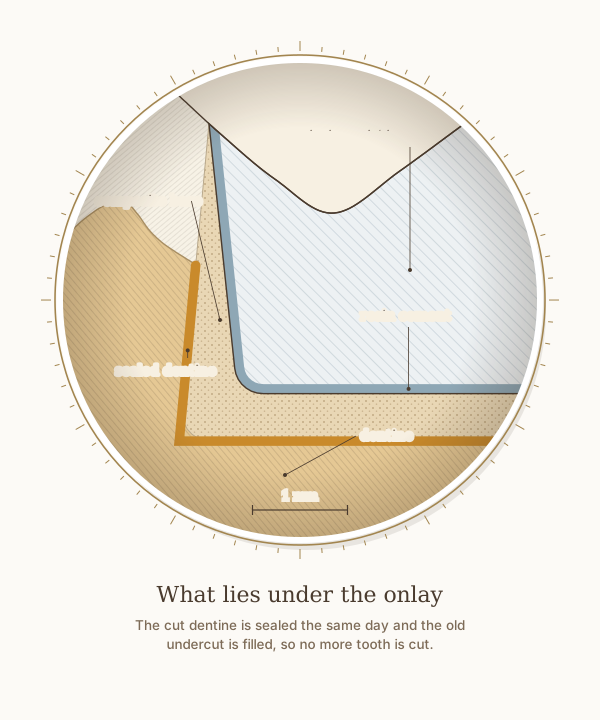
A close-up under the onlay in the step-by-step figure, with a 1 mm scale. Where the old filling left an undercut on the cheek side, a composite base fills it rather than more tooth being cut away; the dentine beneath was sealed the same day, and the onlay is bonded on top with resin cement.
What the drawing is measured from
- Immediate dentine sealing means applying and curing a dentine bonding agent on the freshly cut dentine straight after the preparation, before the impression or scan; a review of more than 30 articles found that it appears to give better bond strength, fewer gaps, less bacterial leakage and less sensitivity. Magne 2005, Journal of Esthetic and Restorative Dentistry, review. DOI
- Measured on 12 molars prepared for onlays, the sealing layer of immediate dentine sealing averaged about 0.12 mm but varied from 0 to 0.5 mm, thickest in the deepest hollow of the preparation and thinnest on its convex edges. Stavridakis, Krejci and Magne 2005, Operative Dentistry. PubMed
- In a randomised trial of 60 lithium disilicate partial restorations on living molars in 30 patients, 98.3 per cent survived 3 years, with no difference between immediate and delayed dentine sealing. van den Breemer et al. 2019, Journal of Dentistry. DOI
- A clinical protocol for bonded inlays and onlays, drawing on the long-term clinical evidence, places an adhesive base (dentine bonding and cavity design optimisation) before the impression, so that the preparation stays more conservative and the steps are easier to follow. Dietschi and Spreafico 2015, The International Journal of Esthetic Dentistry. PubMed
- Drawn as Dr. Khalid prepares for an onlay: the freshly cut dentine sealed straight away, then a composite base that fills the old filling's undercut before the scan, then lithium disilicate, sandblasted, etched with hydrofluoric acid, cleaned with phosphoric acid and primed with silane, bonded with resin cement under rubber dam. The cement and the sealing are drawn 0.1 mm thick, as in the step-by-step figure; their thickness is representative, not measured.
Use this diagram
Free to use, including commercially, with credit.
This diagram is published under CC BY 4.0. You may reproduce it in articles, teaching material, presentations and patient information, print or online, without asking. The one condition is that you credit Dr. Khalid Aletaibi and link back to this page.
It is published this way on purpose. The measurement in this drawing is not something the people selling the treatment tend to publish, so it is more useful spread than kept.
Credit line
What lies under the onlay. Dr. Khalid Aletaibi, CC BY 4.0. https://khalidaletaibi.com/en/diagrams/onlay-under
HTML embed
<figure>
  <img src="https://khalidaletaibi.com/figures/onlay-under-en.svg" alt="What lies under the onlay" width="100%">
  <figcaption>
    What lies under the onlay. <a href="https://khalidaletaibi.com/en/diagrams/onlay-under">Dr. Khalid Aletaibi</a>,
    <a href="https://creativecommons.org/licenses/by/4.0/">CC BY 4.0</a>
  </figcaption>
</figure>