Measured diagram
How does a gum pocket heal after deep cleaning?
The pocket closes mostly by a long seal of gum along the cleaned root, plus a little shrinkage of the gum edge; bone already lost does not grow back by itself. On average pockets were 1.4 mm shallower and about three in four closed at 6 to 8 months.
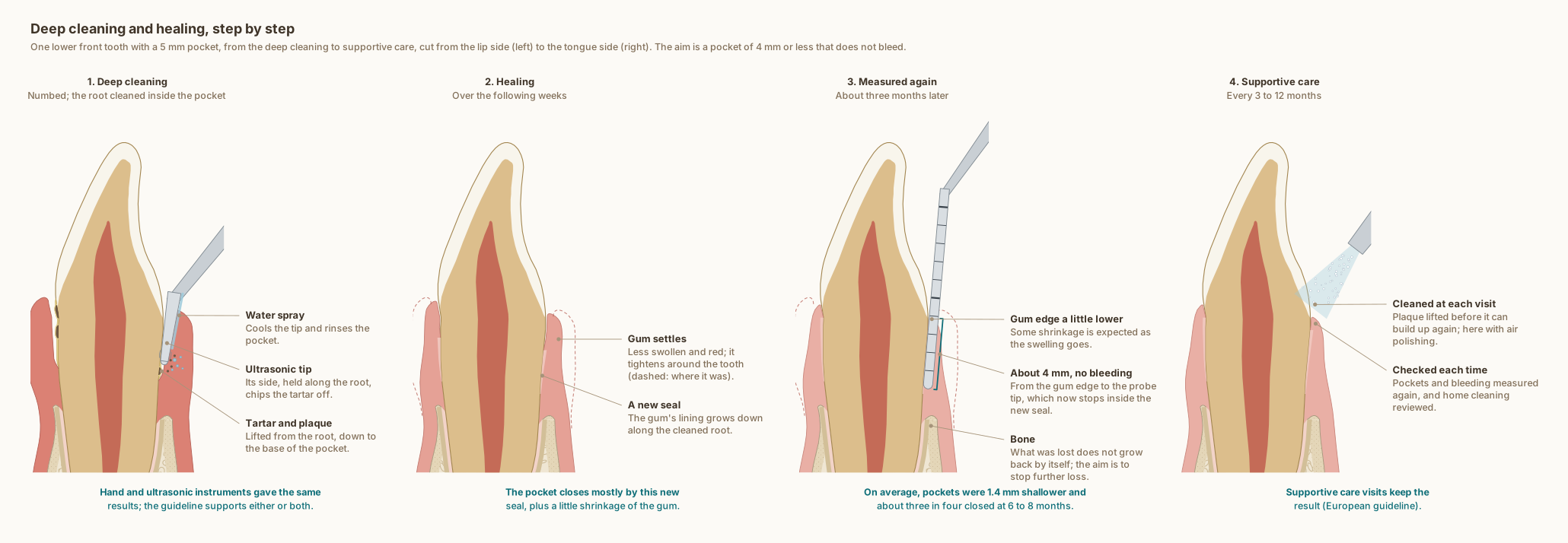
What the drawing is measured from
- What deep cleaning achieves: in the systematic review behind the European guideline, pockets were on average 1.4 mm shallower and about three in four had closed at 6 to 8 months. DOI 1
- How a pocket heals after root planing: by a long junctional epithelium along the cleaned root, with no new connective tissue attachment and no new bone (monkey studies; in humans, five of six control teeth showed the same at three months, Yukna 2007). DOI 2
- How much of the change is gum shrinkage: in 68 patients, 4 to 6 mm sites became 1.03 mm shallower with a 0.69 mm gain in measured attachment, so about a third of the change was the gum edge settling lower. DOI 3
- Where the probe stops in a pocket: in untreated pockets the tip went 0.29 mm (Magnusson and Listgarten 1980) and 0.45 mm (Fowler 1982) past the epithelium into inflamed tissue, well short of the bone; after treatment it stopped inside the epithelium. DOI 4
- The European guideline (EFP S3): the aim is no pocket deeper than 4 mm that bleeds and none of 6 mm or more; sites are re-assessed after healing; hand or powered instruments, or both; supportive care every 3 to at most 12 months. DOI 5
- Using an ultrasonic tip: the side of the last 1 to 2 mm is held close to parallel to the tooth with light pressure (maker's instructions; root damage was least at angles close to 0 degrees, Flemmig 1998). The tip moves only about 5 to 44 micrometres (Lea 2003). DOI 6
- The tooth: a lower central incisor in section, crown 9.5 mm and root 12.5 mm (Wheeler's Dental Anatomy, Table 7.1), with the lip side on the left. Pockets and openings are drawn slightly open so they can be seen; no number on the drawing is a measurement of one person.
Use this diagram
Free to use, including commercially, with credit.
This diagram is published under CC BY 4.0. You may reproduce it in articles, teaching material, presentations and patient information, print or online, without asking. The one condition is that you credit Dr. Khalid Aletaibi and link back to this page.
It is published this way on purpose. The measurement in this drawing is not something the people selling the treatment tend to publish, so it is more useful spread than kept.
Credit line
Deep cleaning and healing, step by step. Dr. Khalid Aletaibi, CC BY 4.0. https://khalidaletaibi.com/en/diagrams/periodontal-treatment-steps
HTML embed
<figure>
  <img src="https://khalidaletaibi.com/figures/periodontal-treatment-steps-en.svg" alt="Deep cleaning and healing, step by step" width="100%">
  <figcaption>
    Deep cleaning and healing, step by step. <a href="https://khalidaletaibi.com/en/diagrams/periodontal-treatment-steps">Dr. Khalid Aletaibi</a>,
    <a href="https://creativecommons.org/licenses/by/4.0/">CC BY 4.0</a>
  </figcaption>
</figure>