Measured diagram
How can you tell grinding, acid and brushing wear apart?
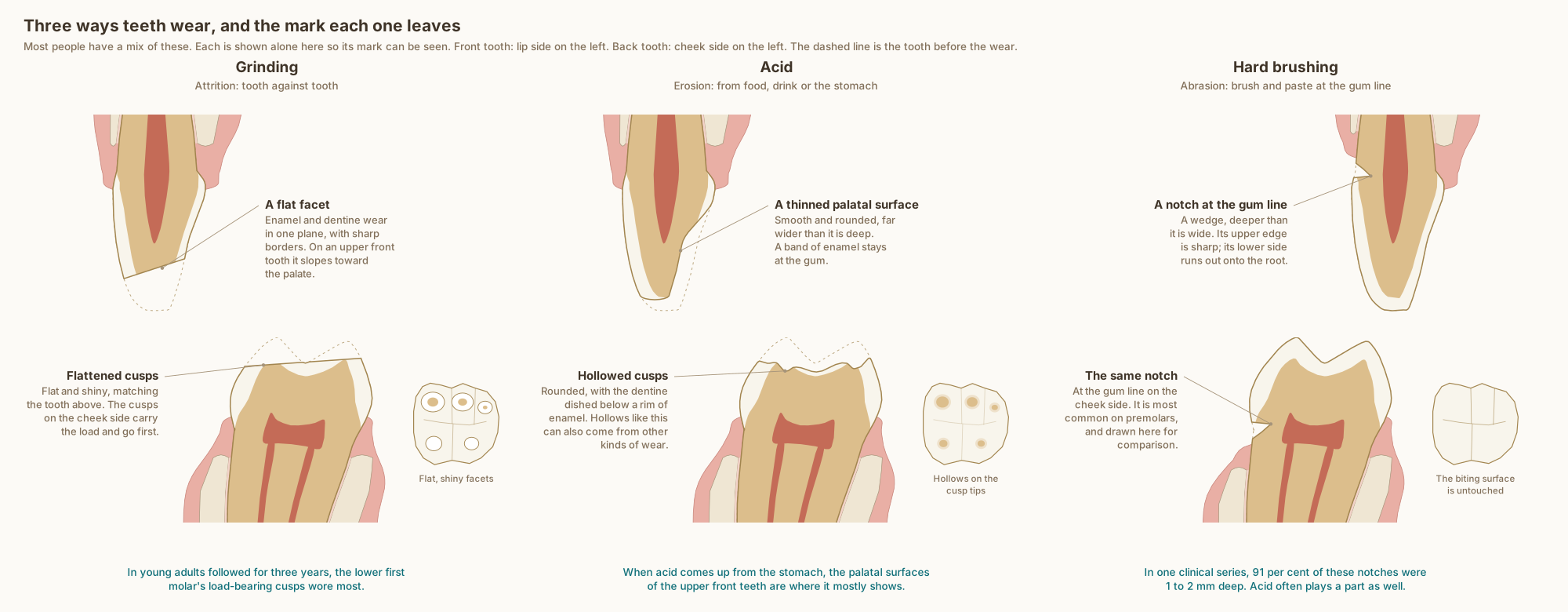
Grinding, acid and hard brushing, each shown alone on the same upper central incisor and lower first molar, with the biting surface beside each molar. Most people have a mix of these, and shape alone cannot prove the cause.
What the drawing is measured from
- European consensus report on erosive tooth wear: attrition gives flat, sharp-bordered, glossy facets that match the opposing tooth; erosion gives flattening, cupping and concavities wider than deep, often with an intact rim at the gum margin; abrasion lies at the gum line, its upper part cutting into enamel at a right angle and its lower part running out onto the root. DOI 1
- The grades: the Tooth Wear Evaluation System 2.0 grades the biting surface of a tooth by wear within the enamel, dentine exposed with up to a third of the crown's height lost, a third to two thirds lost, and two thirds or more. It also lists the signs of mechanical and chemical wear. No grading scale has been validated against measured tissue loss on a single tooth, so these drawings illustrate grades and do not measure them. DOI 2
- An expert review: where attrition exposes dentine, it stays flat and in one plane with the enamel, and shiny, well-defined facets are a sign that it is active. DOI 3
- Woelfel's Dental Anatomy: wear facets on the incisal edges of upper incisors slope cervically toward the palate. No study gives a facet angle, so none is printed here.
- Lower first molars of young adults, scanned over three years: the load-bearing cusps wore most, in the order mesiobuccal, distobuccal, distal; lingual cusps were mostly faceted; and cupped lesions seemed to develop from facets. DOI 5
- A review of erosion: in erosion the width of a smooth-surface defect clearly exceeds its depth; in brushing wear at the gum line, the depth exceeds the width. DOI 6
- The shape of hollowed dentine, in buccolingual sections: depth was about a third of breadth in erosion (0.33) and about a sixth in abrasion (0.15 to 0.19). The groups also differed in ancestry. DOI 7
- Hollows are not proof of acid: in one comparison, deep cupping of more than 0.5 mm was found in 78% of medieval skulls with an abrasive diet and 45% of people on an acidic diet, so cupping is the least certain sign of erosion in adults. DOI 8
- With vomiting-associated eating disorders, the risk of erosive wear is mainly on the palatal surfaces of the incisors. DOI 9
- Cervical lesions in 57 patients and 171 teeth: 91% had an axial depth of 1 to 2 mm and 46% were on premolars, first premolars most. DOI 10
- A review: most authors now regard erosion as the most important factor in lesions at the gum line, so brushing is rarely the whole explanation. DOI 11
- The teeth are the measured upper central incisor and lower first molar used in every figure on this site. How deep each worn surface, hollow and notch is drawn is representative, not a measurement of one patient.
Use this diagram
Free to use, including commercially, with credit.
This diagram is published under CC BY 4.0. You may reproduce it in articles, teaching material, presentations and patient information, print or online, without asking. The one condition is that you credit Dr. Khalid Aletaibi and link back to this page.
It is published this way on purpose. The measurement in this drawing is not something the people selling the treatment tend to publish, so it is more useful spread than kept.
Credit line
Three ways teeth wear, and the mark each one leaves. Dr. Khalid Aletaibi, CC BY 4.0. https://khalidaletaibi.com/en/diagrams/tooth-wear-causes
HTML embed
<figure>
  <img src="https://khalidaletaibi.com/figures/tooth-wear-causes-en.svg" alt="Three ways teeth wear, and the mark each one leaves" width="100%">
  <figcaption>
    Three ways teeth wear, and the mark each one leaves. <a href="https://khalidaletaibi.com/en/diagrams/tooth-wear-causes">Dr. Khalid Aletaibi</a>,
    <a href="https://creativecommons.org/licenses/by/4.0/">CC BY 4.0</a>
  </figcaption>
</figure>